



When EPDM Rubber Roofing Needs Replacement: 7 Signs
Knowing when your EPDM rubber roofing system has reached the end of its useful life is not always straightforward. EPDM is one of the longest-lasting flat roofing materials available, and it can be repaired rather than replaced in many situations. The challenge is recognizing when the damage or deterioration has progressed beyond what repairs can realistically address, and when continuing to patch a failing system is costing more than a full replacement would. Here is what this guide covers:
- What EPDM rubber roofing is and how long it typically lasts
- The seven signs that indicate replacement is the right call
- How to distinguish between a repair situation and a replacement situation
- What affects EPDM lifespan and performance
- How to extend the life of an existing system
What Is EPDM Roofing and How Long Does It Last?
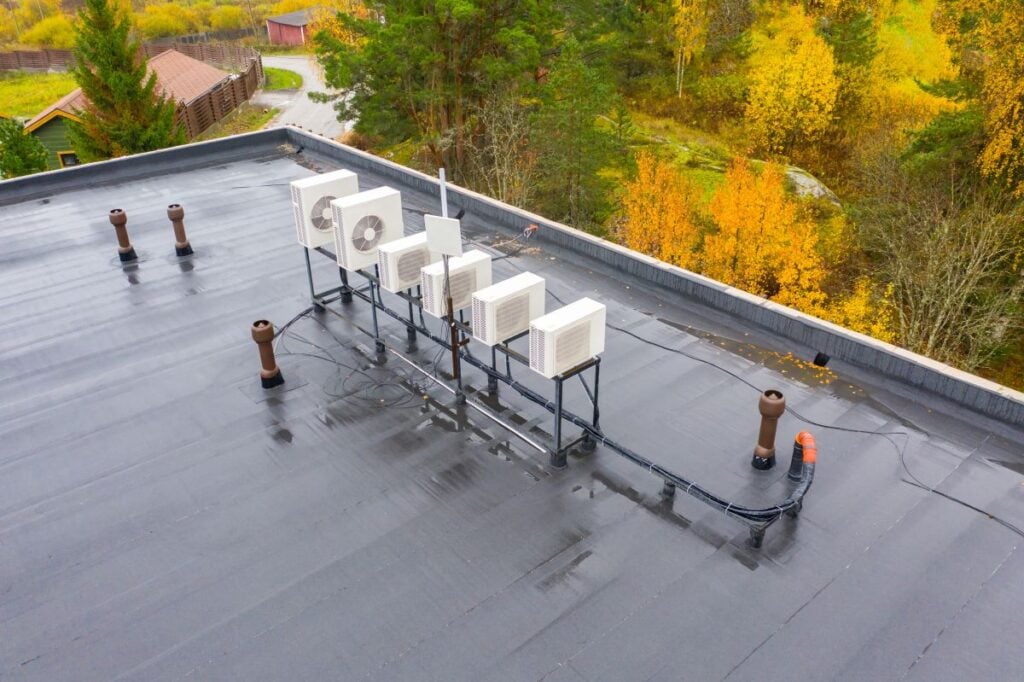
EPDM, which stands for ethylene propylene diene monomer, is a synthetic rubber membrane widely used on flat and low-slope roofs in both residential and commercial applications. It is available in black and white, comes in thicknesses ranging from 45 to 90 mils, and can be installed using adhered, mechanically attached, or ballasted methods. Its dimensional stability allows it to expand and contract through temperature extremes without cracking, which is part of why it performs well in climates that see significant seasonal variation.
In the EPDM Roofing Association’s 2025 survey of 569 roofing professionals, respondents reported expected service lives ranging from approximately 25 years to more than 40 years depending on membrane thickness and attachment method, with many reporting EPDM roofs still performing reliably at 40, 45, and even 50 years of age. That range reflects how significantly installation quality, maintenance history, and climate exposure affect real-world performance. In Surrey, BC, and across the Lower Mainland, the combination of heavy annual rainfall and mild but persistent wet seasons puts ongoing demand on flat roofing systems, making proactive monitoring especially important.
EPDM vs. Other Flat Roofing Systems
| System | Average Lifespan | Key Strength | Common Weakness |
| EPDM | 25 to 50+ years | Cold-weather flexibility, proven longevity | Seam vulnerability if adhesive fails |
| TPO | 20 to 30 years | Heat-welded seams, energy efficient | Shorter track record than EPDM |
| PVC | 20 to 30 years | Chemical resistance, strong seams | Higher upfront cost |
| Modified Bitumen | 10 to 20 years | Granulated surface, familiar installation | Shorter lifespan, heavier |
7 Signs Your EPDM Rubber Roofing Needs Replacement
Knowing the specific signs that indicate replacement, rather than repair, gives property owners a clear framework for making the right decision before interior damage escalates. These seven signs point to a system that has moved beyond the scope of targeted repair work.
1. Widespread Seam Failure
EPDM seams are bonded with adhesive tape or liquid adhesive, and they represent the most vulnerable points in the membrane system. A single seam separation is a repair. Multiple seams pulling away across the roof, particularly when the adhesive is visibly deteriorated or brittle, indicates that the bonding system has reached the end of its functional life. When seams are failing broadly, repairing each one individually is a temporary measure that does not address the system-wide adhesive breakdown driving the problem.
- What to look for: Lifted or peeling seam edges, visible gaps between membrane sections, or water staining directly beneath seam locations.
- Repair vs. replacement: Isolated seam failures on an otherwise sound membrane are repairable. Systemic seam failure across multiple areas of the roof points toward replacement.
- Compounding risk: Failed seams in a wet climate like the Lower Mainland allow ongoing water infiltration with every rainfall event, accelerating damage to insulation and decking below.
2. Significant Membrane Shrinkage
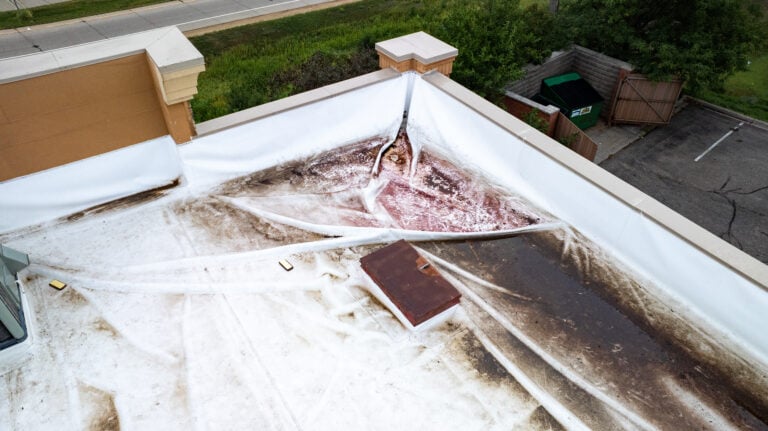
EPDM can shrink over time, particularly as it ages, pulling away from flashings, walls, and roof edges. Minor thermal movement is normal, but significant shrinkage that creates visible gaps at the perimeter or causes the membrane to pull up from its substrate is a structural concern. Once the membrane has contracted enough to compromise its attachment at critical edges, the entire waterproofing system is at risk.
- What to look for: Gaps between the membrane and parapet walls, flashing pulling away from vertical surfaces, or a visible drawing-in of the membrane at roof edges.
- Why it matters: Shrinkage-related gaps are direct entry points for water and are difficult to address permanently once the membrane has contracted significantly.
- Thickness consideration: Thinner 45-mil membranes are more susceptible to shrinkage than 60 or 90-mil systems over time.
3. Extensive Cracking or Surface Brittleness
EPDM is valued for its flexibility, which allows it to perform through temperature extremes without cracking. When the membrane begins to crack across the surface or becomes brittle and stiff to the touch, it has lost that flexibility and can no longer accommodate the movement it was designed to handle. Surface cracking that extends through the membrane, rather than just the surface coating, is a sign of advanced material degradation.
- What to look for: Network cracking across flat sections, brittleness when the membrane is bent slightly, or deep cracks visible around penetrations and flashings.
- UV exposure factor: Black EPDM absorbs more heat than white, and prolonged direct sun exposure accelerates surface hardening over time.
- Repair limitation: Patches applied over a brittle membrane do not bond reliably because the substrate itself is no longer structurally sound.
4. Persistent Ponding Water
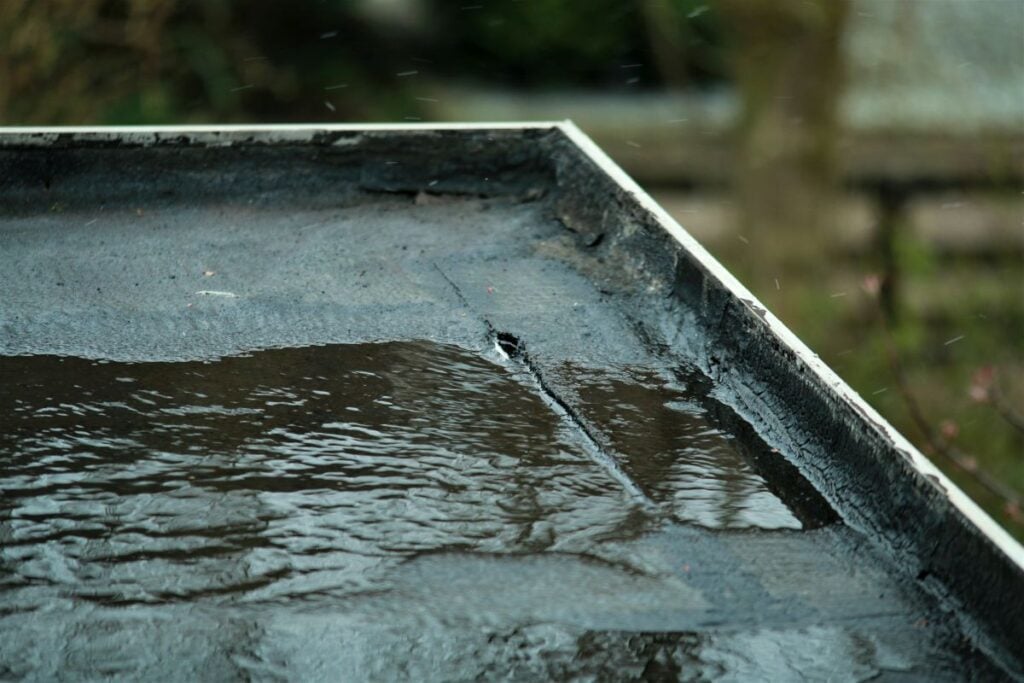
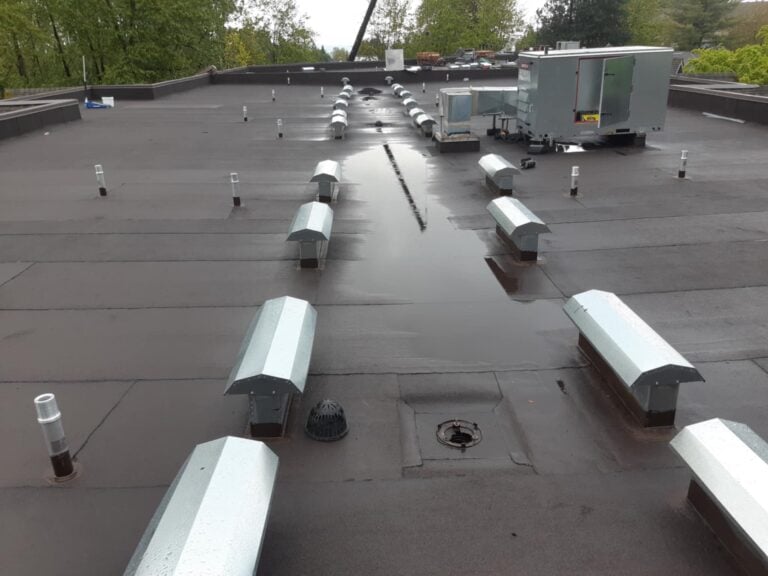
EPDM can tolerate short-term standing water, but water that remains on the roof surface for more than 48 hours after rainfall is a problem regardless of membrane condition. Persistent ponding water indicates a drainage issue that will continue to stress the membrane over time, accelerating deterioration, encouraging biological growth, and adding structural load. When ponding has been occurring for years and the membrane beneath shows visible softening or staining, the combination of drainage failure and membrane wear often points toward replacement.
- What to look for: Areas of consistent discoloration or biological growth indicating where water routinely sits, and soft or spongy sections of membrane beneath those areas.
- Drainage correction: Replacement should be paired with a drainage assessment to correct the underlying slope or drain issue, otherwise the problem repeats on the new membrane.
- Insulation impact: Long-term ponding saturates the insulation below the membrane, which must be replaced as part of any full system installation.
5. Blistering or Bubbling Across the Surface
Blisters and bubbles in an EPDM membrane indicate that air or moisture has become trapped between the membrane and the substrate below. Small blisters that remain stable are often monitored rather than repaired immediately, but widespread blistering that is growing or has begun to rupture signals that the membrane’s bond with the substrate has failed broadly. Once blisters rupture, the membrane is open to water infiltration and the damage spreads rapidly.
- What to look for: Raised sections of membrane that feel hollow when pressed, visible domes across the roof surface, or areas where ruptured blisters have left the membrane loose and unsupported.
- Installation root cause: Widespread blistering often traces back to inadequate surface preparation or adhesive application at the time of installation.
- Replacement scope: When blistering is widespread, the full membrane and affected insulation typically need to be removed and replaced rather than patched.
6. Recurring Leaks Despite Multiple Repairs
A repaired EPDM roof that continues to leak in the same or new locations is telling you something important: the system as a whole is failing, not just isolated sections. Each leak repair addresses a symptom without resolving the underlying deterioration. When a property owner has had the same roof repaired multiple times over a short period, the cumulative cost of those repairs is often approaching or exceeding what a full replacement would cost, without delivering the long-term performance a new system would provide.
- What to look for: Interior water staining that returns after repair, new leak locations appearing each season, or repair patches that fail within months of application.
- Cost comparison: If the cost of repairs over the next two to three years is projected to approach 50% of replacement cost, replacement becomes the more financially sound decision.
- Insurance consideration: A roof with a documented history of repeated leaks may affect claims and coverage depending on how the insurer categorizes ongoing maintenance failures.
7. Age Combined With Visible Deterioration
Age alone is not a reason to replace an EPDM roof that is otherwise performing well. However, a roof approaching or past 25 to 30 years of service that is also showing multiple signs of surface deterioration, seam weakness, or membrane shrinkage has reached the window where replacement planning should begin. Continuing to invest repair costs in an aging system with compounding problems is rarely the most cost-effective path.
- What to look for: A roof over 20 years old showing two or more of the signs listed in this guide simultaneously, or one showing advanced deterioration in a single critical area.
- Thickness advantage: Thicker membranes installed decades ago often outperform their rated lifespan. Age assessment should always be paired with a physical membrane condition evaluation.
- Planning window: Identifying the need for replacement before emergency failure allows time to plan for the cost and schedule the work during a dry seasonal window.
Extending the Life of Your EPDM System

For roofs that are not yet at the replacement threshold, proactive maintenance can add meaningful years to system performance. Regular professional inspections twice per year and after significant storm events catch seam separation, minor punctures, and drainage issues before they escalate. Keeping the surface clear of debris, addressing ponding water promptly, and applying a protective coating to aging membranes are all cost-effective measures that delay replacement without compromising protection. We’re proud to serve home and business owners in Surrey, BC, and nearby communities with EPDM roofing inspections, repairs, full replacements, and more.
Army Roofing Gives You a Straight Answer on Your EPDM Roof
At Army Roofing, we assess EPDM systems honestly and tell you whether repair or replacement is the right call for your specific situation. We do not recommend replacement when a repair will genuinely solve the problem, and we do not patch roofs that need to be replaced. If your flat roof is showing any of the signs covered in this guide, contact Army Roofing today for a free inspection and find out exactly where your system stands.
Recent Articles
The Roof Blog